Product Description
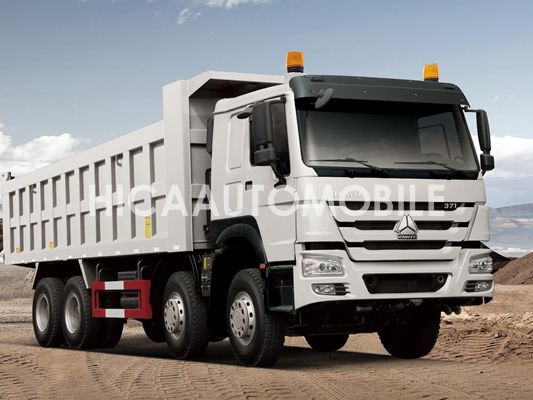
The SITRAK C7H 8x4 dump truck puts a second steer axle under the MAN TGA technology platform Sinotruk has built since 2013, which takes it to twelve wheels, MAN-technology tandem axles and a body in the 30 cubic metre class. The reason to buy it is arithmetic rather than specification: on a long haul the fourth axle is not a cost, it is the thing that spreads cost. This page works through when that trade pays and when a 6x4 is the cheaper truck.
Why the Platform Carries a Twelve-Wheel Tipper
A twin-steer tipper is not a 6x4 with an axle added at the end of the line. The front end of the C7H chassis comes from the MAN TGA programme and is laid out to take two steering axles from the start. That layout does two jobs on site: it splits the front share of a large loaded body across two axles and four steer tyres instead of one, so the body can grow without the front end becoming the limit, and it lets a twelve-wheel SITRAK C7H 8x4 dump truck track through a tight stockpile without a single heavily loaded steer axle scrubbing.
Behind the cab the platform is the family that made C7H the widest-supported SITRAK series in export markets: MC11 or MC13 power from 310 to 480 HP, a ZF gearbox, and MAN-technology tandem axles. A tipper is judged on days worked per year, and a SITRAK C7H 8x4 dump truck from a long production run has the shortest path from a failure to a running truck.
The Fourth Axle as an Economic Argument
Cost per tonne delivered on a SITRAK C7H 8x4 dump truck is cost per cycle divided by tonnes per cycle. The top line is dominated by things that do not change when the body grows: the driver's shift, the loading event, the queue at the shovel, the queue at the tip, the fuel burnt standing still. The bottom line is the only term a bigger body moves. On a short haul you can recover a payload deficit by running more cycles inside the shift, which is why a 6x4 holds its own on a short tip run. On a long haul travel time sets how many cycles a truck can complete, and no amount of hustling adds a cycle the clock will not allow.
That is where the SITRAK C7H 8x4 dump truck changes the sum. If a plant needs a fixed tonnage per day and each truck completes fewer cycles because the haul is long, the only routes to the target are more trucks or more tonnes per cycle. More trucks means more drivers, more tyre sets, more services, more machines in the workshop. More tonnes per cycle means one truck doing the work of one and a half. The extra axle costs a pair of tyres and some fuel on every kilometre, and that cost scales with distance while the payload gain scales with tonnage, so the longer the haul, the thinner the axle cost is spread.
Ordering a Body in the 30 Cubic Metre Class
Volume without density flatters. A 30 cubic metre class body loaded with dry aggregate and the same body loaded with wet ore are two different trucks as far as the axles are concerned, so body class has to be chosen against bulk density and the axle ratings behind it. Give us the material, the density and the daily tonnage the plant needs, and the body, the plate thickness and the SITRAK C7H 8x4 dump truck behind it can be matched to the job rather than to a brochure.
Then settle what cannot be changed after build on a SITRAK C7H 8x4 dump truck. Emission level has to match the sulphur in the fuel you can actually buy. Steering position is a build decision. The body drawing needs approval before fabrication: plate thickness by zone, U-shaped or rectangular, wear plate grade, cylinder type, tailgate. Confirm whether the truck ships complete or as a chassis for local body assembly, and which port it leaves from.
Frequently Asked Questions
What body size does this tipper carry?
A body in the 30 cubic metre class. Plate thickness, shape and lining are set at order against the material, because volume alone says nothing about the mass the axles will see.
Is an 8x4 worth it over a 6x4?
On a short tip run, no, because a 6x4 recovers its payload deficit by completing more cycles. On a long haul where travel time caps cycles per shift, the SITRAK C7H 8x4 dump truck wins: payload per cycle is the only lever left and the axle cost is diluted across a larger daily tonnage.
How does C7H compare with the other 8x4 tippers?
All share MAN-derived chassis architecture; the difference is platform age and cost. Choose the SITRAK C7H 8x4 dump truck when export parts coverage and resale value matter, because C7H has the longest production run. The G7 reaches a lower entry price with a locally built engine and gearbox, the G7H adds the high-roof flat-floor cab, and the C9H is the 2022 flagship on a separate cab and chassis design. Take C7H for the best-supported balance, G7 for budget, G7H for driver retention, C9H for the heaviest duty.
Does the fourth axle raise running costs?
It adds a pair of tyres and some fuel per kilometre on a SITRAK C7H 8x4 dump truck. Whether that shows in cost per tonne depends on haul length: the cost scales with distance, the payload gain scales with tonnage.
Can a SITRAK C7H 8x4 dump truck be supplied right-hand drive?
Yes. Steering position is fixed at build, so confirm the market at enquiry and the build sheet, lighting and instrumentation will be correct on arrival.
Tags:
Technical Parameters
Zambia Customer Feedback
Nigeria Customer Feedback
| Series / cab | SITRAK C7H, MAN TGA technology platform since 2013, twin-steer |
| Drive form | 8x4, twelve wheels |
| Engine | MC11 or MC13 diesel, MAN technology |
| Max. power | 310 to 480 HP, rating quoted at order |
| Transmission | ZF gearbox |
| Drive axle | MAN-technology tandem axles |
| Emission standard | Confirmed at order to match destination fuel quality |
| Steering | Left-hand or right-hand drive, set at order |
| Body / fifth wheel | Tipper body in the 30 cubic metre class, plate and shape built to material |
| Application | Long-distance mine and quarry haulage, earthworks, plant feed |
| Options | Wear plate grade, tailgate, rock shield, body-only chassis supply |