Product Description
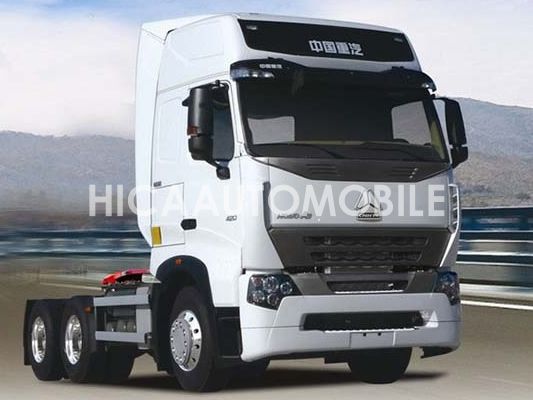
The SITRAK C7H 6x4 tractor truck is the export workhorse of the range: MAN TGA technology built in series since 2013, MC11 or MC13 power from 440 to 540 HP, a ZF 16-speed gearbox and MCY13Q tandem axles. Three things make it the safe order. It has the widest parts coverage of any SITRAK series, which is a downtime argument rather than a specification argument. Its second drive axle gives traction redundancy on ramps that are not sealed. And its long production run gives it resale value in markets where buyers know the platform.
Parts Depth Is the Real Specification
Every tractor is reliable on the day it is delivered. The question is what happens in year four, far from a dealer, when a hub seal fails. On a low-volume model that is a fabrication job and a week of emails. On the C7H it is a stock item, because the platform has been built continuously since 2013 and its parts have been distributed into export markets for the whole of that run. A SITRAK C7H 6x4 tractor truck is therefore compared against other trucks not on paper but on days lost.
Two consequences follow for a SITRAK C7H 6x4 tractor truck. The first is price and choice of supply: a part with several sources, including independent suppliers, is a part you can shop for. The second is workshop familiarity, which is harder to buy and worth more. A fitter who has rebuilt a C7H hub knows the torque sequence without a manual, and that shortens every repair for the life of the vehicle. MAN TGA lineage is what underwrites both, because the service literature and the tooling follow the platform, not the badge on the grille.
Traction Redundancy on Unsealed Ramps
A 6x4 tractor drives through two rear axles and ten wheels in contact with the ground. On sealed highway that is more driveline than the job needs, and it costs fuel and tyres against a 4x2. On an unsealed port road, a wet mine ramp or a mud season, it is the difference between a schedule and a recovery truck. When one drive axle loses grip on a SITRAK C7H 6x4 tractor truck, the other still has load on it and still pulls, and the inter-axle differential lets them run at different speeds through a turn.
The loaded case is where this matters most, because a tractor is heaviest and least manoeuvrable where the surface is worst. A SITRAK C7H 6x4 tractor truck also spreads its own mass and the kingpin load over more tyres, which keeps it on top of soft ground instead of cutting two deep ruts and stopping. If your route is sealed end to end, a 4x2 costs less per kilometre; the case for the 6x4 is that it does not need the road inspected before it commits.
What to Fix at Order
Start with the rating. MC11 and MC13 are both offered between 440 and 540 HP, and the correct choice depends on the gross combination you pull, the gradients on your corridor and the altitude. A rating chosen for a flat coastal route will be worked hard on an inland climb, and the fuel penalty of the bigger engine is smaller than the penalty of running the smaller one flat out. Confirm the emission level against the sulphur content of the fuel you can actually buy, because a common-rail engine and high-sulphur diesel is an expensive combination.
Then the hardware that cannot be changed later: left-hand or right-hand drive, fifth-wheel height and rating, tank capacity and material, and whether the SITRAK C7H 6x4 tractor truck is required with a retarder for long descents. Confirm the port and the delivery term, and ask for the build sheet in writing so the specification you approve is the specification that is built. A SITRAK C7H 6x4 tractor truck ordered against a written corridor description is a predictable purchase; one ordered against a photograph is not.
Frequently Asked Questions
What driveline does a SITRAK C7H 6x4 tractor truck use?
MC11 or MC13 power between 440 and 540 HP, a ZF 16-speed gearbox and MCY13Q tandem axles, all on the MAN TGA technology platform that SITRAK has built since 2013.
Why does parts availability matter more than specification?
Because a tractor earns nothing while it waits. The SITRAK C7H 6x4 tractor truck has the widest export parts coverage of any SITRAK series and the longest production run, so common failures are stock items and workshops already know the procedures.
How does C7H compare with the other 6x4 tractors?
The C5H uses Weichai power, so its parts network differs and its entry price is lower. The G7 keeps MAN-derived chassis architecture but moves to a locally built engine and gearbox to cut cost. The C9H is the 2022 flagship on a separate cab and chassis design. Choose the SITRAK C7H 6x4 tractor truck when the widest parts coverage and the strongest resale value matter most, C5H when your workshop is a Weichai workshop, G7 for the lowest cost per unit on moderate duty, and C9H for flagship long-haul duty.
Is a 6x4 necessary if I only run sealed roads?
No. A 4x2 carries the same combination with less tyre and fuel cost. The SITRAK C7H 6x4 tractor truck is the right order when any part of the route is unsealed, steep or seasonal, or when the trailer is loaded at a site rather than on tarmac.
Does the platform hold its value?
Better than a low-volume model, because a used buyer can price a known platform, find parts for it and insure it without research. That resale advantage is a direct result of the production run that started in 2013.
Tags:
Technical Parameters
Zambia Customer Feedback
Nigeria Customer Feedback
| Series / cab | SITRAK C7H, MAN TGA technology platform since 2013 |
| Drive form | 6x4 |
| Engine | MC11 or MC13 diesel, MAN technology |
| Max. power | 440 to 540 HP, rating quoted at order |
| Transmission | ZF 16-speed gearbox |
| Drive axle | MCY13Q tandem axles |
| Emission standard | Confirmed at order to match destination fuel quality |
| Steering | Left-hand or right-hand drive, set at order |
| Body / fifth wheel | Tractor unit, fifth wheel height and rating confirmed at order |
| Application | Long-haul and regional haulage, port and cross-border corridors |
| Options | Retarder, tank capacity and material, cab type, tyre specification |